AI SEO is the work of making useful information easy for search engines and answer systems to find, understand, and cite. The industry has given parts of this work newer names, including answer engine optimization (AEO) and generative engine optimization (GEO). The names are changing faster than the fundamentals.
The fundamentals are still recognisable: a crawlable website, clear entities, direct answers, trustworthy evidence, sensible internal links, and independent sources that confirm who you are. AI search changes where the answer appears and how it is assembled. It does not make credibility optional.
This article is the educational hub for that subject. Businesses looking for an audit or implementation can use NodeAscend’s SEO company in Faridabad page; keeping the two intents separate makes this guide more useful and the service page more honest.
This post explains how generative AI engines process and evaluate business content — and why the gap between “ranking on Google” and “getting cited by ChatGPT” is wider than most businesses in Faridabad, Delhi NCR, and across India currently realize.
Key Takeaways
- ChatGPT, Gemini, Perplexity, and Claude each use different retrieval methods — your content may pass one and fail all others
- AI engines prioritize named entities, direct answers, and structured data over keyword density
- A site can rank #1 on Google and remain completely absent from AI-generated responses
- Indian businesses face a geographic disadvantage in AI citations due to thinner English-language authority content for local markets
- Schema markup and crawlable page structure are the two fastest-impact changes for AI visibility
- Topical depth across multiple pages matters more to AI engines than a single well-optimized page
- AI search is not replacing Google — but it is capturing research-intent queries that used to drive top-of-funnel traffic
AI Search Engines Don’t Work Like Google
Google crawls your site, indexes pages, and ranks them against keyword queries. You can see positions, clicks, impressions in Search Console. The feedback loop is measurable.
Generative AI engines work differently. When a user asks ChatGPT “which is the best digital marketing agency in Faridabad,” the model doesn’t run a live search of your website. It draws on:
- Pre-training data — web content crawled during model training (often months old)
- Real-time retrieval — for tools like Perplexity and Gemini with live search active
- User-provided context — documents and links pasted directly into the conversation
The implication: ranking on Google does not guarantee your content made it into any AI model’s training data at sufficient quality, nor that Perplexity’s retrieval layer considers your page authoritative enough to surface.
Two entirely separate battles. Winning one doesn’t win the other.
Three Names for Overlapping Work
The terms are useful as planning labels, but they are not three sealed departments:
| Term | Primary focus | Typical work |
|---|---|---|
| SEO | Visibility and clicks from search results | Crawling, indexing, intent, content, links, local signals, conversion |
| AEO | Direct answers in search and assistants | Concise definitions, question-led sections, entities, structured content |
| GEO | Inclusion and citation in generative responses | Retrievable evidence, source clarity, corroboration, topical depth, monitoring |
A sensible strategy begins with one trustworthy source of truth. It makes that source technically accessible, gives important questions clear answers, connects related pages, and presents the organization and its authors consistently. Independent mentions then give other systems a reason to believe the claims.
Creating three near-identical pages because the acronyms are different usually adds less value than improving the evidence all three pages would have repeated.
How ChatGPT, Gemini, and Perplexity Actually Process Your Content
Understanding the pipeline is not about gaming the system — it’s about understanding why certain businesses consistently get cited and others don’t.
Your Website
    ↓
Web Crawlers
(CommonCrawl, Bing, Google, Perplexity's own crawler)
    ↓
Content Processing Filters
    ├── Is the page crawlable? (robots.txt, JS rendering, load speed)
    ├── Is the content structured? (headings, paragraphs, schema)
    ├── Does content directly answer questions? (Q&A format, FAQs)
    └── Is the entity (business name) consistent across sources?
    ↓
Training Corpus or Live Retrieval Index
    ↓
AI Model Evaluation
    ├── Is this source authoritative on the topic?
    ├── Does this directly answer the user's query?
    └── Is this consistent with what other sources say?
    ↓
AI-Generated Response — Your business cited, or not
A slow-loading page that takes 4+ seconds to render its main content may not be crawled deeply. A page where the business name appears inconsistently — “NodeAscend”, “Node Ascend Technologies”, “Nodeascend” — creates entity ambiguity that AI engines flag as low confidence. A page with 500 words of generic service descriptions but no direct question-answer pairs does not get retrieved.
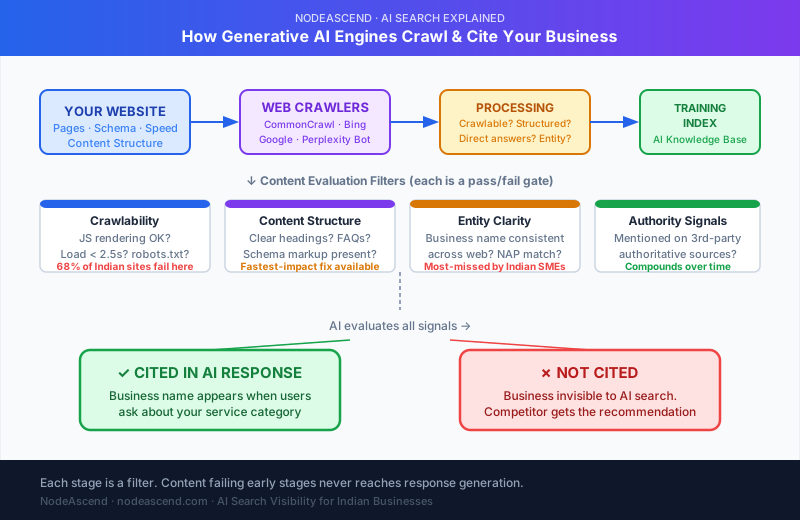
Each stage in this pipeline is a filter. Content that fails early never reaches the response generation layer.
What Signals AI Engines Use to Cite a Business
Each AI company keeps retrieval specifics proprietary. But based on observed citation patterns and published research from Google on AI Overviews and Perplexity’s documentation, several signals consistently influence whether a business appears:
Named entity clarity. AI engines build knowledge graphs of real-world entities — businesses, people, services, locations. If your business name, address, and category appear consistently across your website, Google Business Profile, LinkedIn, and third-party directories, the AI can build a confident entity entry. Inconsistency across sources fragments this representation and lowers citation confidence.
Direct question-answer format. Generative retrieval strongly favors content that answers a specific question in the opening sentence of a section — the answer first, then context. A FAQ that opens with “What does website development cost in India? Custom website development in India ranges from ₹25,000 to ₹5,00,000 depending on complexity…” performs far better in AI retrieval than the same information buried in paragraph 4 of a service page.
Schema markup. LocalBusiness, Organization, Article, Service, and other appropriate schema types communicate structured information to crawlers in machine-readable form. Schema can clarify meaning but does not guarantee an AI citation or rich result, and it must match visible page content.
Third-party corroboration. If your business is mentioned on industry publications, news sites, or authority forums — not just on your own website — AI engines weight this as a trustworthiness signal. A digital agency in Faridabad mentioned on a technology news site gets cited with higher confidence than one that exists only on its own website and local directories.
Topical depth across the domain. AI engines evaluate topical authority at the domain level. A site with 15 pages covering different aspects of digital marketing — strategy, local SEO, analytics, content, results — signals deeper expertise than a site with one service page. Depth compounds.
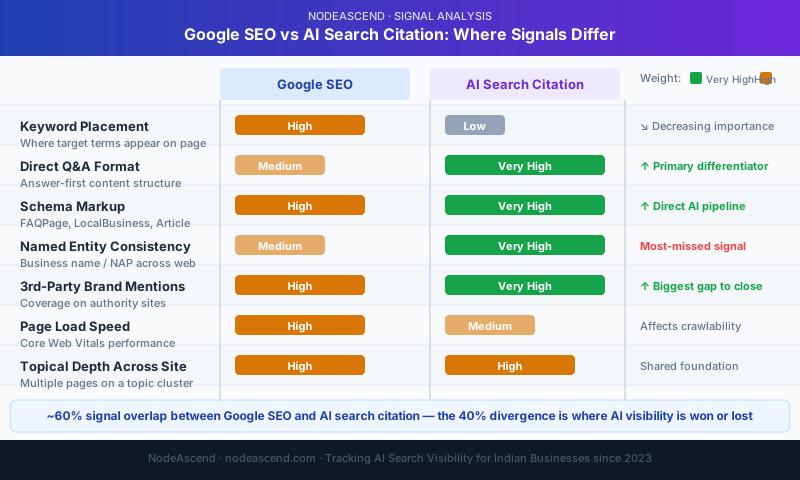
The signal overlap between Google SEO and AI citation is roughly 60%. Schema markup, entity clarity, and third-party mentions matter significantly more for AI retrieval than for traditional keyword ranking.
Why Indian Business Websites Are Invisible to AI Engines
The AI visibility gap for Indian businesses is measurable and has three primary causes:
Content depth and language. AI training data skews heavily toward English-language, Western-origin content. An Indian agency doing excellent client work but publishing thin service pages, no case studies, and no original data gets outweighed in training data by Western competitors with larger content archives. The fix is not to become Western — it is to build depth in the areas where Indian businesses have real expertise and real results.
Entity establishment gaps. Many Indian businesses operate without consistent digital entity signals. The business name differs between GST registration, Google Business Profile, website header, and business card. Local directories like Justdial and IndiaMart often have incomplete or differently formatted listings. AI engines, which rely on cross-source consistency to build entity confidence, treat these as weak signals — and weak entities don’t get cited.
Technical barriers to crawling. JavaScript-gated content, slow or unreliable responses, accidental robots rules, inconsistent canonicals, and missing internal links can limit discovery. Check each important page in rendered HTML and review crawler access intentionally instead of assuming every AI provider uses the same retrieval path.
For local markets like Faridabad specifically — where the volume of English-language business content is a fraction of what exists for Bengaluru or Mumbai — the competitive baseline is lower. A business that establishes clear entity signals and structured content stands out proportionally more. Early movers gain disproportionate citation share with relatively modest investment.
The practical opportunity for Faridabad and NCR businesses is to publish clearer local evidence than generic national directories: named services, real operating areas, useful answers, consistent organization details, and approved case evidence. Those improvements also support conventional local SEO and conversion.
What Changes When You Optimize for Both Google and AI Search
The foundations are shared — quality content, technical health, authoritative backlinks — but the differentiators diverge:
| Signal | Google SEO Weight | AI Citation Weight |
|---|---|---|
| Keyword placement | High | Low |
| Direct question-answer format | Medium | Very High |
| Schema markup | High | Very High |
| Consistent entity (name, NAP) | Medium | Very High |
| Topical depth across site | High | High |
| Third-party brand mentions | High | Very High |
| Page load speed | High | Medium |
| Content freshness | Medium | Medium |
The shift is from keyword positioning to entity and answer clarity. A business that appears in AI-cited responses for “web development company in Faridabad” doesn’t necessarily appear because it used that phrase on a page. It appears because AI engines built a confident knowledge graph entry for that business linked to those service categories and geography.
NodeAscend’s SEO company in Faridabad approach treats traditional and AI-assisted discovery as parallel tracks because both depend on accurate, structured, trustworthy content. Our Google Business Profile guide for India covers an important part of the local layer.
Measuring Something That Refuses to Sit Still
AI answers vary by model, date, mode, location, and sometimes by the way a question is phrased. That makes a triumphant screenshot a poor baseline. A useful measurement process repeats the same branded, category, comparison, problem, and local questions and records which sources were cited, whether the brand appeared, and whether the answer was accurate.
Those observations should sit beside Search Console queries, branded demand, referral traffic where it is visible, and actual enquiries. Citation frequency can show direction. It cannot yet provide the neat attribution story most dashboards would like to sell.
What I Would Fix in the First 30 Days
I would begin with access: can a crawler receive the important content as rendered HTML, under one reliable canonical URL? Then I would standardize the organization’s name, location, services, authors, and profiles across the properties it controls.
The next pass would be editorial. Important sections should answer the question early, then explain the evidence, limits, and next step. Schema should describe visible content rather than decorate it. Supporting articles should link to the correct educational hub or commercial page, not whichever URL happens to contain a similar keyword.
Finally, I would publish something competitors cannot reproduce by rearranging generic advice: an approved case study, a detailed process, original observations, a useful tool, or a clearly sourced point of view. Then I would establish a repeatable prompt baseline and review it monthly.
Questions to Ask Before Hiring an AI SEO Agency in India
The market for AI SEO services in India has grown quickly, and so have agencies making claims about “AI visibility” without clear methodology. Before engaging any agency:
Ask for specific AI citation examples — not screenshots of Google rankings, but actual ChatGPT or Perplexity responses citing their client’s business by name. Ask how they measure AI visibility changes over time and what tools they use to track it. Ask whether they can audit your current entity signals across directories, not just your Google rankings.
Ask vendors to show the prompt set, date, model, citation source, and tracking method behind examples. A screenshot without a repeatable method can be selected for a favorable answer and does not prove durable visibility.
Get a technical audit — no pitch
Frequently Asked Questions
What is AI search visibility and how is it different from Google SEO?
AI search visibility is whether your business is cited by ChatGPT, Gemini, Perplexity, or Claude when users ask questions about your service. Google SEO is about ranking in search result pages. These are separate systems using different signals — a page can rank on Google page 1 and be absent from all AI-generated responses.
How do ChatGPT and Gemini decide which Indian businesses to recommend?
AI engines evaluate named entity consistency across the web, structured content with schema markup and direct Q&A formatting, third-party corroboration on authority sites, and topical depth across the domain. Businesses with strong entity signals and direct-answer content are cited more consistently than those with generic service pages.
Do Indian businesses have a disadvantage in AI search compared to Western companies?
Yes. AI training data skews toward English-language Western content. Indian businesses with thin content and inconsistent entity signals face a higher bar. However, local Indian markets — particularly Tier 2 cities like Faridabad — have lower content density, meaning early movers gain disproportionate citation share with relatively modest structured content investment.
How long does it take to see improvement in AI search visibility?
For live retrieval tools like Perplexity, structured content improvements can produce citation changes within 4 to 8 weeks. For base model responses, timelines depend on when those models are next trained on fresh crawl data. Entity signals tend to improve citation rates faster than content volume alone.
Is AI SEO relevant for small businesses in Faridabad?
Directly relevant. When a user asks an AI about the best web design company in Faridabad, the AI works from a thinner dataset than for Mumbai or Bengaluru. A small business that builds clear entity signals and structured content can appear in AI citations for local queries where larger competitors have not optimized.