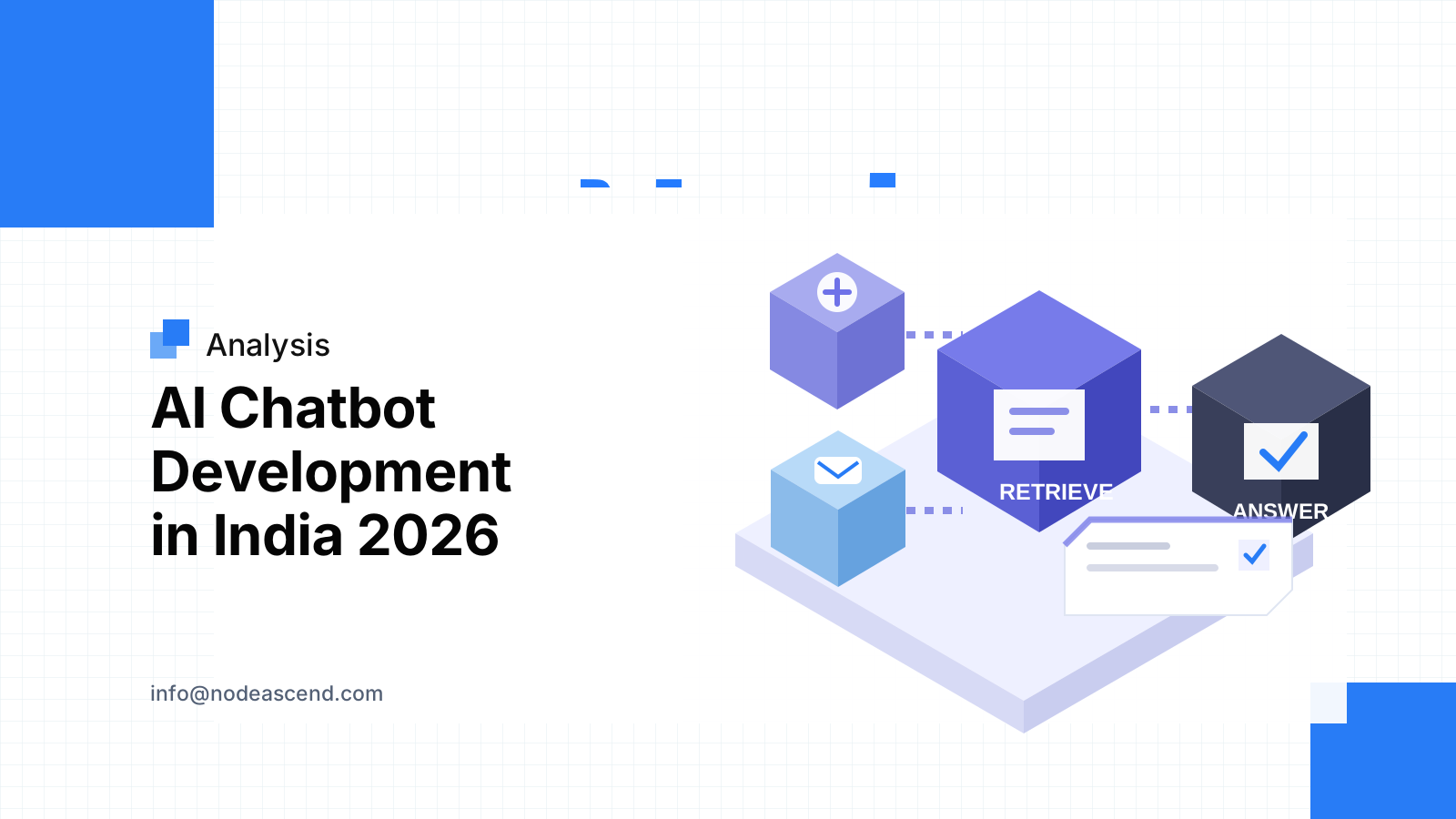
AI chatbot development in India is no longer mainly about putting a chat bubble on a website. The real work is deciding what the bot should know, what it should never guess, and when it should quietly hand the conversation to a person.
That distinction matters. A polished demo can answer five prepared questions and still fall apart the first time a customer writes in Hinglish, sends an incomplete order number, or asks about a policy that changed last week. This guide is about the less glamorous version: building a chatbot that can survive an ordinary working day inside an Indian business.
Types of AI Chatbots in 2026
Not all chatbots are equal. Before you build, understand what you actually need:
1. Rule-Based Chatbots
Uses decision trees: “Press 1 for enquiry, press 2 for support.” No AI involved.
Cost: ₹5,000–₹15,000
Best for: Simple FAQ bots, lead capture forms disguised as chat
Limitation: Breaks the moment a user says something unexpected
2. LLM-Powered Chatbots (Generic)
Uses GPT-4, Claude, or Gemini to respond to any question. No custom knowledge.
Cost: ₹15,000–₹30,000
Best for: General customer support where questions are unpredictable
Limitation: Can hallucinate answers; may mention competitors; knows nothing about your specific products
3. RAG Chatbots (Recommended for Businesses)
RAG = Retrieval-Augmented Generation. The AI searches your own documentation, product catalogue, or FAQ before responding. Answers are grounded in your real business data.
Cost: ₹35,000–₹1,00,000
Best for: Any business where accuracy matters — real estate listings, hospital FAQs, legal documents, product specs
This is what NodeAscend builds — as a specialist AI development company in Faridabad, we design, build, and deploy these RAG-based systems end-to-end for Indian businesses.
The RAG Architecture Explained Simply
User Question
      ↓
Vector Search (finds the most relevant chunks from your docs)
      ↓
GPT-4 / Claude receives: [relevant context] + [user question]
      ↓
AI generates an answer grounded in YOUR data
      ↓
User gets accurate, source-cited response
The key component is a vector database (we use Pinecone or Qdrant) that stores your documents as embeddings — mathematical representations that enable semantic search (“find me sections about refund policy” even if the user didn’t use those exact words).
WhatsApp Chatbot vs Website Widget: Which Should You Build First?
For many Indian businesses, WhatsApp is the natural place to begin. Customers are already there, and they already use it to ask for prices, send documents, confirm appointments, and chase updates. There is no new behaviour to teach.
That does not mean WhatsApp should be chosen automatically. Meta’s pricing and conversation categories change, and every outbound message carries rules that a website widget does not. The right choice depends on where conversations already happen, not on which channel appears more impressive in a proposal.
Website AI widget is second priority for businesses with significant website traffic (5,000+ monthly visitors).
How We Build AI Chatbots at NodeAscend
Step 1: Document Ingestion
We collect your: FAQ documents, product catalogues, service descriptions, pricing pages, policy documents, past email Q&As.
Step 2: Chunking + Embedding
Documents are split into semantic chunks (300-500 tokens each) and embedded using OpenAI’s text-embedding-3-large model or a local alternative.
Step 3: Vector Store Setup
Embeddings are stored in Pinecone (managed) or Qdrant (self-hosted for data privacy). Each chunk is indexed with metadata (source, date, category).
Step 4: Retrieval + Generation
When a user asks a question:
- The question is embedded (converted to vector)
- Top-k similar chunks are retrieved from the vector store
- These chunks + the original question are sent to GPT-4o
- GPT-4o generates a response using ONLY the provided context
- Source citations are included so users can verify
Step 5: Integration
- WhatsApp: Meta WhatsApp Business Cloud API via webhook
- Website: Embed a React widget or iframe
- CRM: Optionally log conversations to HubSpot, Zoho, or your custom CRM
Real Pricing for Indian Businesses (April 2026)
| Chatbot Type | Setup Cost | Monthly Running Cost |
|---|---|---|
| WhatsApp Rule-Based | ₹10,000 | ₹2,000–₹5,000 |
| Website LLM Widget | ₹20,000 | ₹3,000–₹8,000 (API costs) |
| WhatsApp RAG Bot | ₹45,000 | ₹5,000–₹15,000 |
| Full RAG System (web + WhatsApp + CRM) | ₹85,000 | ₹10,000–₹25,000 |
API costs depend on model choice, input size, response length, retrieval volume, and conversation count. Treat the table as a planning range and request a usage model based on your expected traffic; provider prices change too frequently for a fixed token-rate promise.
The Conversation to Have Before Asking for a Quote
Most chatbot estimates begin too late. A vendor is shown a website, told to “add AI,” and asked for a price. The predictable result is a quote for the visible interface, while the difficult questions stay outside the document.
Start with the conversations themselves. Which ones are repetitive enough to automate? Which ones involve refunds, health, legal advice, account changes, or an upset customer and should always reach a person? Then look at the knowledge behind those answers. It may be spread across website pages, PDFs, a CRM, product sheets, and the memory of one employee who has been answering the same questions for six years.
You also need to decide whether the bot only talks or can act. Booking an appointment, updating a CRM, creating a support ticket, or taking a payment changes the risk and the engineering considerably. Language matters too. A bot that performs well in formal English may respond very differently to Hindi, Hinglish, abbreviations, and voice-note transcripts.
By the time these questions are answered, the brief becomes much more honest. It describes an operating system for a small part of the business, not a demo with a chat box.
The Bot Needs Permission to Say “I Don’t Know”
This is one of the hardest product decisions because it makes a demonstration look less magical. It also makes the real system far more trustworthy.
Customer conversations can contain phone numbers, addresses, order details, medical information, contracts, or internal documents. The bot should collect only what it needs, and public knowledge should be kept separate from restricted material. Someone must decide how long conversations are retained, who can see them, and what the model provider is allowed to do with the data.
Escalation is part of the experience, not evidence that automation failed. If retrieval confidence is low, a policy is disputed, or the customer is clearly frustrated, the bot should pass the conversation to a named team. The handoff should include a short summary and the details already collected. Nobody enjoys explaining the same problem twice, especially after being told the first listener was intelligent.
Test the Awkward Questions, Not Only the Easy Ones
Before launch, write down the questions customers actually ask. Include the vague ones, the misspelled ones, the bilingual ones, and the ones based on an old policy. Add questions the bot must refuse and situations where the correct answer is a human handoff.
For each, record what a good response looks like. Then test whether the bot found the right source, stayed within that source, cited it when necessary, and took the correct next action. Repeat the same tests whenever documents, prompts, models, or integrations change.
This is less exciting than asking a model random questions in a meeting. It is also how you learn whether the chatbot is improving.
What a Sensible First Month Looks Like
The first week is usually spent cleaning up knowledge, not writing prompts. Contradictory price sheets, expired policies, and duplicated FAQs will confuse a retrieval system in the same way they confuse staff.
The second week is where the conversation begins to take shape: how documents are split, which metadata is preserved, what the bot asks before qualifying a lead, and how it responds when no reliable answer is found. In the third week, the system is connected to WhatsApp or the website, the CRM, analytics, and the human support queue.
Then comes a controlled launch. A small group uses it, transcripts are reviewed, weak answers are traced back to their sources, and the test set is run again. Expanding traffic before this stage is how a manageable knowledge problem turns into a public reputation problem.
Frequently Asked Questions
How much does AI chatbot development cost in India?
A narrow lead-capture or FAQ bot may start in the tens of thousands of rupees. A production RAG system with WhatsApp, CRM actions, access controls, evaluation, and monitoring can cost materially more. Data quality, integrations, languages, traffic, and risk are stronger cost drivers than the chat interface.
Should I use OpenAI, Gemini, Claude, or an open-source model?
Choose after testing your actual questions. Compare answer quality, latency, privacy controls, context limits, tool use, regional availability, and operating cost. The retrieval and evaluation design often matters more than the brand of model.
Can the chatbot answer in Hindi or Hinglish?
Modern models can handle Hindi, English, and Hinglish, but you should test domain terms, spelling variation, and tone with representative users. Approved source content may also need bilingual versions for reliable retrieval.
How do I prevent hallucinations?
Ground answers in approved sources, require citations where appropriate, constrain unsupported claims, set confidence-based fallback rules, and evaluate difficult questions before launch. No model is error-free, so sensitive actions still need human control.
Who should own the chatbot after launch?
Give the system two owners. A business owner should be responsible for whether the answers are still true. A technical owner should watch integrations, access, failures, and operating cost. The most useful review is often the list of unanswered questions; it shows exactly where the business itself has not documented an answer.
Key Takeaways
- RAG chatbots (grounded in your own data) are far more accurate than generic LLM bots
- WhatsApp is often the strongest first channel when customers already use it for enquiries
- Setup cost is ₹35,000–₹1,00,000; running costs are ₹5,000–₹25,000/month
- Resolution rate should be measured from your own approved use cases rather than assumed from a generic benchmark
- Data location, retention, provider settings, and human escalation should be documented before launch
If you are considering a chatbot, begin with ten real customer conversations rather than a feature list. NodeAscend’s AI automation team in Faridabad can review the workflow, the available knowledge, and whether AI is even the right solution before a build is scoped.